 |


| Quantity: | |
|---|---|
AA,BB,CC
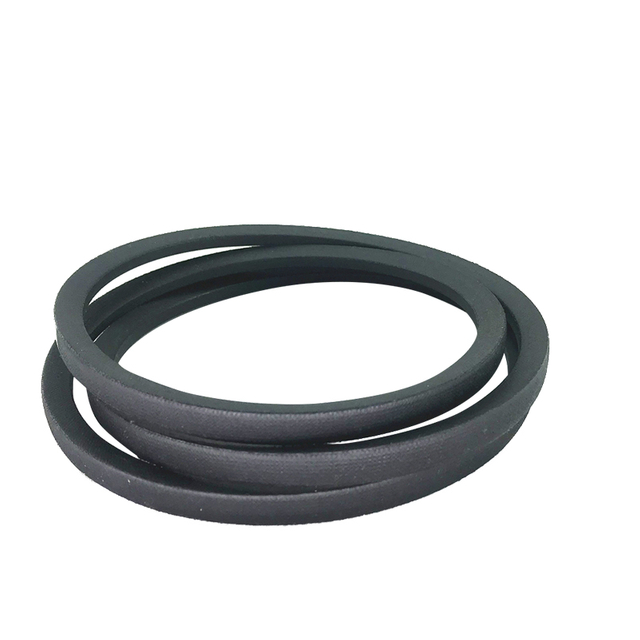
Hexagonal V belts, also known as double V belts or hex belts, are power transmission belts with a hexagonal cross-section that enables power transmission from both the top and bottom surfaces. This dual-sided capability makes them suitable for serpentine drive layouts where pulleys contact both sides of the belt and some driven shafts require rotation reversal.
The belt features two V profiles joined at the back, creating a hexagonal shape with four angled sidewalls. The top and bottom surfaces are recessed to maintain sidewall contact with pulley grooves while preserving flexibility. Each side functions independently as a V belt, allowing the belt to drive pulleys on either side of the belt path without flipping or re-routing.
The belt body is constructed from a rubber compound, typically polychloroprene or EPDM, formulated for flex resistance and environmental stability. A tensile cord of polyester or aramid fiber runs along the neutral plane to carry tension loads. The sidewall surfaces are fabric-covered for abrasion resistance and consistent friction characteristics against pulley groove walls.

Section | Top Width (mm) | Height per Side (mm) | Total Height (mm) | Angle (degrees) |
|---|---|---|---|---|
AA | 13.0 | 8.0 | 16.0 | 40 |
BB | 17.0 | 11.0 | 22.0 | 40 |
CC | 22.0 | 14.0 | 28.0 | 40 |
Operating temperature range is -45°C to +80°C for standard rubber compounds. Length tolerance conforms to ISO 5289 specifications. The belt's symmetric design means both sides carry equal load ratings, and the belt can be installed in either orientation without affecting performance. Flex life is rated for continuous operation with proper tensioning and sheave alignment.
Hexagonal belts are specified for serpentine drive arrangements where the belt must contact pulleys on both sides, such as systems with backside idlers or reverse-rotation driven shafts. The dual V profile eliminates the need for multiple belts or complex routing in applications requiring power transfer to shafts rotating in opposite directions.
AA and BB sections are commonly used in textile machinery including spinning frames, looms, and yarn processing equipment where multi-shaft transmission and reverse rotation are required. BB and CC sections serve agricultural machinery such as combine harvesters, balers, and seed drills, where drive layouts demand power transfer from both belt sides across multiple shafts.
Production adheres to ISO 5289 for double V belt dimensions and tolerances, DIN 772 for German industrial standards, and RMA (Rubber Manufacturers Association) specifications for North American markets. Belt length markings follow the standard numbering system corresponding to inside length measurements.
Each batch undergoes dimensional inspection including top width, total height, and angle verification. Tensile strength testing confirms cord integrity, and length matching ensures belts supplied as sets fall within matched tolerance bands. Lot identification codes provide traceability to material batches, production date, and quality inspection records.
Hexagonal V belts are used in drive systems that require power transmission from both sides of the belt, such as serpentine drives with backside pulleys, multi-shaft arrangements with reverse rotation, and applications where a single belt must drive multiple shafts rotating in different directions. They are common in textile machinery and agricultural equipment.
AA, BB, and CC refer to the cross-section sizes, corresponding to classical A, B, and C V belt dimensions doubled to form a hexagonal profile. AA is the smallest section with a 13 mm top width and 16 mm total height; BB measures 17 mm by 22 mm; and CC is the largest at 22 mm by 28 mm. Selection depends on power requirements and pulley dimensions.
Yes, hexagonal belts are designed to transmit power from both the top and bottom V profiles. The symmetric hexagonal cross-section allows pulleys to engage with either side of the belt, making them suitable for serpentine drives, reverse-rotation applications, and multi-shaft systems where the belt wraps around pulleys on opposite sides.
Hexagonal V belts conform to ISO 5289 (international standard for double V belts), DIN 772 (German standard), and RMA (Rubber Manufacturers Association) specifications. These standards define dimensional tolerances, length classification, and test methods for belt performance verification.