Views: 0 Author: Site Editor Publish Time: 2026-09-22 Origin: Site


Off-the-shelf power transmission products handle the vast majority of standard industrial applications today. They offer dependable daily performance for conventional drivetrains. However, relying on standard belts for non-standard drivetrains often results in premature failure. You might experience excessive machine downtime or notice severely compromised equipment performance under peak loads. We must establish a clear framework for these high-stakes engineering scenarios. This guide helps you decide whether custom manufacturing is truly justified for your unique machinery. We explore how long-term reliability and continuous operational efficiency offset high initial tooling costs. You will learn exactly when and how to transition away from standard catalog solutions. We will cover advanced failure diagnostics, complex material engineering trade-offs, and critical supplier vetting processes. By understanding these variables, you can confidently upgrade your drivetrain components.
Customization is typically justified by extreme operating environments (heat, chemicals), unique pulley geometries, or legacy equipment constraints.
Altering cogged v belt specifications involves engineering trade-offs, particularly between flexibility (bend radius) and tensile strength.
Minimum Order Quantities (MOQs) and tooling costs are the primary financial barriers to custom runs.
Selecting the right cogged v belt supplier requires vetting their rapid prototyping and dynamic testing capabilities, not just their per-unit pricing.
Differentiating between normal wear and systemic failure is absolutely crucial. Standard belts wear down uniformly over time. They might last thousands of operating hours before degrading. Systemic failures look entirely different. You will spot irregular side-wall glazing almost immediately. You might find snapped tensile cords scattered inside the machine guard. Completely sheared cogs indicate severe trouble. These symptoms usually point to mismatched drive designs. They rarely indicate poor factory manufacturing.
Identifying Systemic Failures: Look for localized burning, rapid tension loss, or asymmetrical wear patterns.
Thermal Degradation: Standard neoprene compounds deteriorate rapidly. This breakdown happens quickly in ambient temperatures exceeding 140°F (60°C). The elastomer hardens under constant heat. It loses grip on the sheave. Eventually, it shatters under dynamic load. If your application runs consistently hotter, you must upgrade the material. A custom EPDM or polyurethane compound becomes strictly necessary. We often see extreme thermal conditions in agricultural harvesting equipment. Heavy-duty commercial HVAC blowers also suffer greatly from intense heat buildup.
Atypical Drive Geometries: Many modern machines feature ultra-compact designs. Engineers frequently use sub-minimal pulley diameters to save space. These tight bends force standard belts into unnatural shapes. They stretch aggressively along outer edges. They compress severely at the bottom. This harsh dynamic causes standard designs to crack. The root of the cog splits open from excessive bending stress.
Power Density Upgrades: Facilities often retrofit older machinery for higher torque. They install stronger motors to boost production. However, the existing pulley envelope rarely changes. You cannot install wider standard belts easily. They will simply not fit the physical constraints. Customizing internal components solves this elegantly. You can transmit much more power through the exact same physical space.
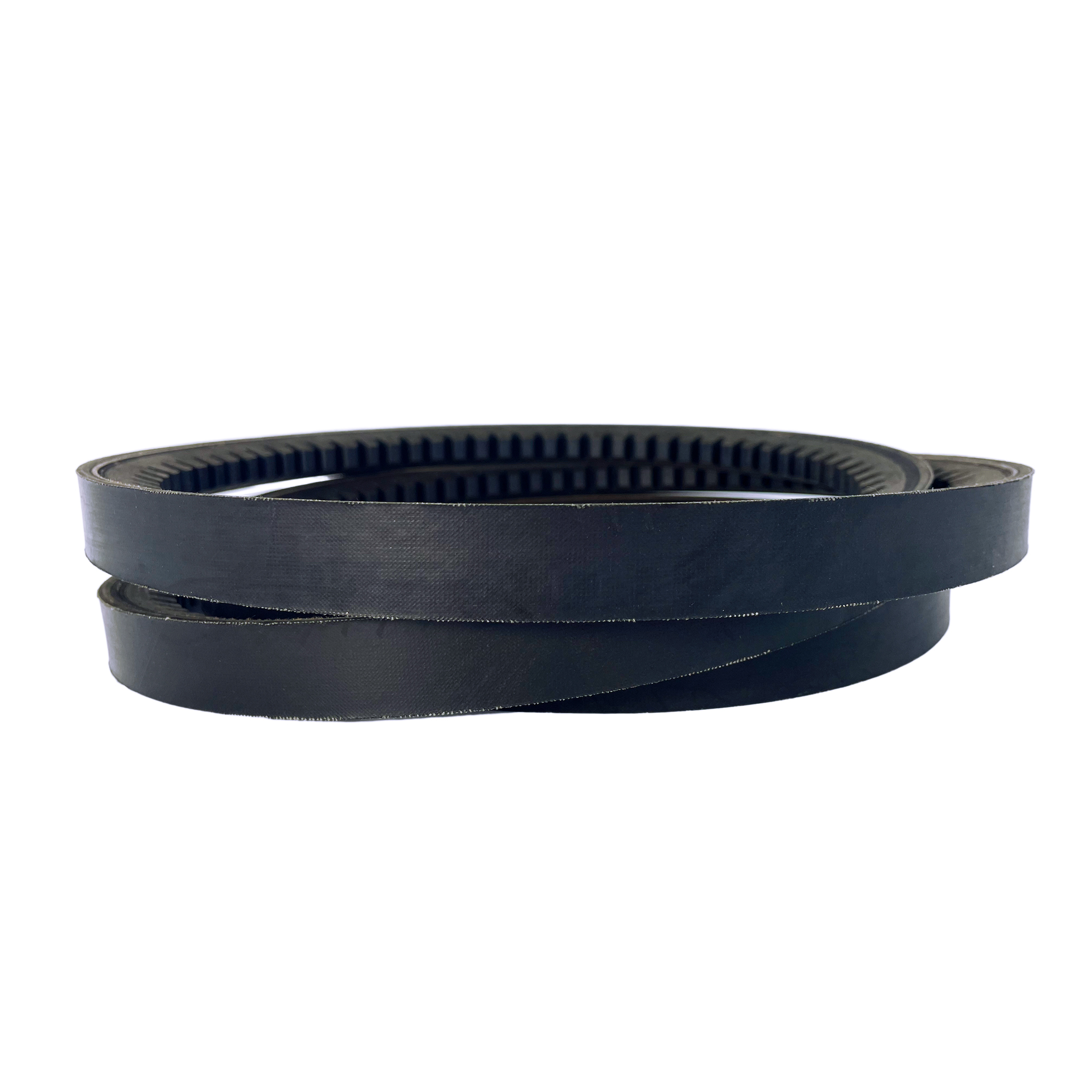
When evaluating a custom cogged v belt, engineers must look closely at several structural parameters. You cannot simply guess which elements need upgrading. Every adjustment changes the dynamic physics of the drivetrain.
Upgrading cover materials provides immediate defense against harsh environments. Standard rubbers degrade quickly when exposed to heavy machine oils, atmospheric ozone, or harsh cleaning chemicals. Customizing the outer wrap prevents this rapid chemical breakdown. You can also modify the base rubber to achieve specialized compliance. Achieving anti-static ratings according to ISO 1813 standards prevents dangerous sparking. Flame-retardant modifications are equally critical. Underground mining applications explicitly dictate these safety choices.
Material Compound Comparison for Custom Belts
Elastomer Base | Thermal Limit | Best Application Environment |
|---|---|---|
Standard Neoprene | Up to 140°F (60°C) | General duty, clean environments, standard HVAC. |
EPDM Rubber | Up to 250°F (121°C) | High heat, extreme weather, outdoor agricultural. |
Polyurethane | Varies heavily by blend | High abrasion resistance, clean room robotics. |
Nitrile (Buna-N) | Up to 212°F (100°C) | Heavy oil exposure, machine tool coolant areas. |
The internal cords handle the actual pulling force inside any drivetrain. Moving away from standard polyester provides massive performance leaps. Upgrading to Kevlar or Aramid cords virtually eliminates unwanted stretch. These advanced materials accommodate heavy shock loads effortlessly. Industrial rock crushers and massive shredders depend heavily on Kevlar. The material prevents catastrophic drive snapping during sudden jams.
Altering the cog depth or pitch fundamentally changes belt behavior. Deeper cogs drastically increase flexibility for complex serpentine drives. They navigate exceptionally small sheaves smoothly without cracking. Conversely, shallower cogs provide much more cross-sectional support. They handle heavy lateral loads better. You must balance exactly how much rubber you remove from the bottom section.
Many legacy machines operate on highly unusual center distances. Standard length increments might leave your tensioners fully maxed out on day one. Specifying non-standard lengths solves this clearance issue perfectly. Furthermore, specifying micro-tolerances for matched sets remains vital. Precise cogged v belt specifications ensure uniform load distribution. Every single belt in a parallel array pulls exactly the same weight.
Every mechanical modification introduces new variables into your equipment. Customization requires careful balance to avoid fixing one problem while creating another entirely.
The flexibility versus lifespan dilemma remains prevalent. Increasing cog depth helps belts navigate tiny pulleys easily. Deeper cuts allow much tighter bend radii. However, deeper cuts inherently reduce overall rubber mass. This reduction potentially lowers the total load-carrying capacity. You trade raw pulling power for extreme flexibility. Engineers must calculate this compromise meticulously.
Acoustic considerations catch many design teams off guard. Custom cog profiles introduce completely new harmonic frequencies. Engineers must account for potential drive noise increases. A modified pitch might cause unpleasant whining at high RPMs. This matters immensely in enclosed factory spaces. Decibel limits are strictly enforced indoors. Consumer-facing appliances also demand exceptionally quiet operation.
Supply chain realities shift dramatically during custom runs. You lose the convenience of next-day distributor shipping. Local shops will not carry your proprietary size. You must hold adequate safety stock onsite. You must forecast usage rates accurately. When partnering with a specialized v belt supplier cogged v belt designs often require customized inventory agreements. Some manufacturers will warehouse emergency stock for you. Others ship the entire production batch immediately.
Financial realities dictate project feasibility upfront. You must factor in Non-Recurring Engineering (NRE) costs. Customized mold fees vary heavily based on the specific cross-section. Strict Minimum Order Quantities (MOQs) apply almost universally across the industry. You might purchase two years of inventory simultaneously. This setup requires dedicated upfront capital allocation.
A successful custom project relies entirely on your manufacturing partner. You need more than a basic rubber production line. You require deep engineering support.
Prototyping capabilities dictate project validation speed. Can the supplier offer small-batch prototype runs? You should test small quantities before buying expensive production molds. Field testing a few dozen units prevents catastrophic disasters. A rigid supplier demanding massive upfront volume signals inflexibility. They likely lack true rapid engineering agility.
Dynamic testing facilities separate premium partners from basic extruders. The manufacturer should provide extensive empirical testing data. They must measure tension decay over thousands of cycles. They must track slip rates under peak torque conditions. Heat generation metrics are equally vital. Relying purely on theoretical math often leads to field failures. Real-world simulation proves the design actually works.
Quality traceability guarantees long-term manufacturing consistency. Your thousandth belt must match your first prototype perfectly. Ensure the cogged v belt supplier utilizes strict batch tracking. They should employ advanced dimensional auditing on the factory floor. Laser profiling scans the finished belt precisely. It guarantees tight consistency across every production run. One single bad batch can halt your entire assembly line.
Before signing off on a custom tooling invoice, weigh your architectural options. Sometimes altering the machine itself makes more sense than altering the belt.
Evaluate the cost-benefit analysis threshold carefully. Compare the long-term financial impact of custom belts against redesigning the equipment. Look at the one-time capital expenditure of upgrading the pulleys. If swapping to larger, standard pulleys takes only a few hours of machining, it might be the superior choice. However, if redesigning the pulleys requires an entire chassis modification, custom belts win easily.
Actionable Next Steps:
Gather precise drive data. Record horsepower (HP), rotational speed (RPM), exact center distance, and peak ambient temperature.
Document specific failure modes of your current standard belts. Capture photographic evidence of root cracking or sidewall glazing.
Consult a dedicated applications engineer. Speak directly to a specialized manufacturer rather than a general industrial distributor.
Customizing a cogged v belt is a strategic engineering decision, not a simple procurement swap. You actively modify chemical compounds and structural geometries to solve specific mechanical failures. While it demands upfront investment in engineering validation and tooling, a properly customized belt permanently resolves chronic bottlenecks. You eliminate constant downtime and unpredictable replacement schedules in specialized machinery. Ultimately, the success of the project hinges entirely on transparent communication of operating parameters. You must work closely with a validated manufacturing partner. Treat your belt as a highly engineered component, and your drivetrain will reward you with uninterrupted, reliable performance.
A: Yes, usually. Cogged belts generally run cooler and handle smaller pulleys better than wrapped belts of the same cross-section. However, ensure your pulleys are not excessively worn. Cogged belts require pristine sidewall contact to transmit power efficiently.
A: MOQs vary heavily by manufacturer and the specific mold required. For existing molds paired with custom materials, it may be a few hundred units. Entirely new dimensions may require thousands of units to justify tooling costs.
A: Depending on the complexity of the material compound and dynamic testing requirements, the prototype-to-production timeline generally ranges from 6 to 16 weeks.
A: Yes. Altering the tensile cord material (e.g., switching to Kevlar) or the cog depth fundamentally changes the elongation characteristics. Your supplier must provide a revised tensioning protocol specific to the custom design.