Views: 0 Author: Site Editor Publish Time: 2026-09-22 Origin: Site


Misidentifying rib profiles leads directly to premature drive system wear. Pairing a ribbed belt and an incompatible pulley creates localized heat buildup. This simple mistake often triggers sudden transmission failure, bringing critical machinery to a halt. For engineers and procurement managers, transitioning from standard V-belts to multi-ribbed profiles requires precise engineering validation. You must verify cross-sections, minimum pulley diameters, and specific operating environments before finalizing a design.
This guide breaks down the critical technical criteria necessary for selecting the correct poly V belt. We decode standard profile designations so you can match the right belt to your specific load requirement. We also outline how to ensure exact pulley alignment across industrial drives and modern engine layouts. Following these engineering principles prevents catastrophic belt shredding. You will learn how to evaluate upgrades, select optimal materials, and mitigate tensioning risks effectively.
Poly V belts offer higher power density and flexibility than traditional V-belts, allowing for smaller drive configurations.
Selecting the correct profile (PH, PJ, PK, PL, PM) depends entirely on the required power rating and the minimum diameter of the driving pulley.
Pulley matching requires strict adherence to groove geometry; even minor pitch deviations can shred a ribbed belt under load.
Modern applications increasingly favor EPDM materials over traditional neoprene (CR) due to superior heat resistance and longevity.
Assessing a drive system upgrade requires clear success criteria. You must determine whether your current setup demands increased rotational speeds, a smaller physical footprint, or enhanced energy efficiency. Traditional single belts often struggle under high-speed demands. They generate excessive heat and require large pulley diameters to prevent cracking. Switching to a multi-ribbed design solves these spatial and thermal constraints.
The truncated rib design of a ribbed belt significantly increases the contact surface area compared to a standard single V-belt. Multiple micro-ribs distribute the load evenly across the pulley face. This wedging action firmly grips the groove walls. Enhanced grip prevents slippage at high rotational velocities. Less slippage translates directly into more efficient power transmission. Engineers can achieve identical power ratings using noticeably narrower pulleys.
Ribbed profiles also excel regarding wrap angles and reverse bending capabilities. Their thinner cross-section provides immense flexibility. This flexibility allows them to navigate complex routing easily. They smoothly accept back-idlers and serpentine configurations. Such adaptability proves absolutely critical for an automotive drive belt routing multiple engine accessories simultaneously. Industrial machinery similarly benefits from this compact routing freedom.
We must acknowledge the practical realities of system implementation. Upgrading an existing drive requires a complete replacement of all drive pulleys. Initial conversion costs naturally run higher. You are replacing standard flat or deep-groove pulleys with precision multi-groove hardware. However, these upfront equipment costs offset themselves rapidly. You gain substantially reduced maintenance intervals, eliminate constant re-tensioning, and achieve longer operational lifespans.
System Attribute | Standard V-Belt | Poly V Belt |
|---|---|---|
Contact Surface Area | Limited to two side flanks. | Expansive across multiple micro-ribs. |
High-Speed Stability | Prone to whipping and slippage. | Exceptionally stable at high RPMs. |
Reverse Bending | Poor; prone to rapid cracking. | Excellent; readily accepts back-idlers. |
Space Requirements | Requires large, bulky pulley setups. | Enables highly compact drive designs. |
Proper profile selection dictates both your system load capacity and geometric constraints. Engineers utilize a universal framework dividing ribbed profiles into five primary categories. Each letter designation corresponds to a specific rib pitch. Pitch measures the exact distance between the center of one rib and the center of the adjacent rib. Matching this pitch to your application ensures structural integrity.
The PH and PJ profiles represent the smallest pitch designs available. Manufacturers engineered these sections for lightweight machinery and precision equipment. They operate seamlessly over exceptionally small pulleys. You will frequently find PJ profiles inside medical centrifuges, fitness treadmills, and home appliances. They deliver smooth, vibration-free performance under low-torque conditions.
Moving up the scale brings us to the highly versatile K-section. This mid-range pitch offers outstanding flexibility combined with robust power transfer. A standard PK belt dominates the global automotive sector. It serves as the definitive standard for the modern engine compartment. It easily handles extreme RPMs while conforming tightly to compact alternator and water pump pulleys.
Heavy-duty applications demand PL and PM profiles. These large-pitch belts handle massive torque loads across industrial power transmission setups. PM sections feature incredibly thick tensile cords. They power massive industrial compressors, agricultural combines, and rock crushers. These belts cannot negotiate tight bends. They require massive minimum pulley diameters to function correctly.
Sizing involves serious risk mitigation. We warn strongly against adopting a "close enough" mentality during specification. Attempting to mix a metric-designed belt alongside a similarly sized imperial pulley creates immediate misalignment. The mismatched pitch geometry forces the ribs to ride awkwardly atop the groove peaks. This exact scenario leads to rapid rib shear and total catastrophic failure within hours.
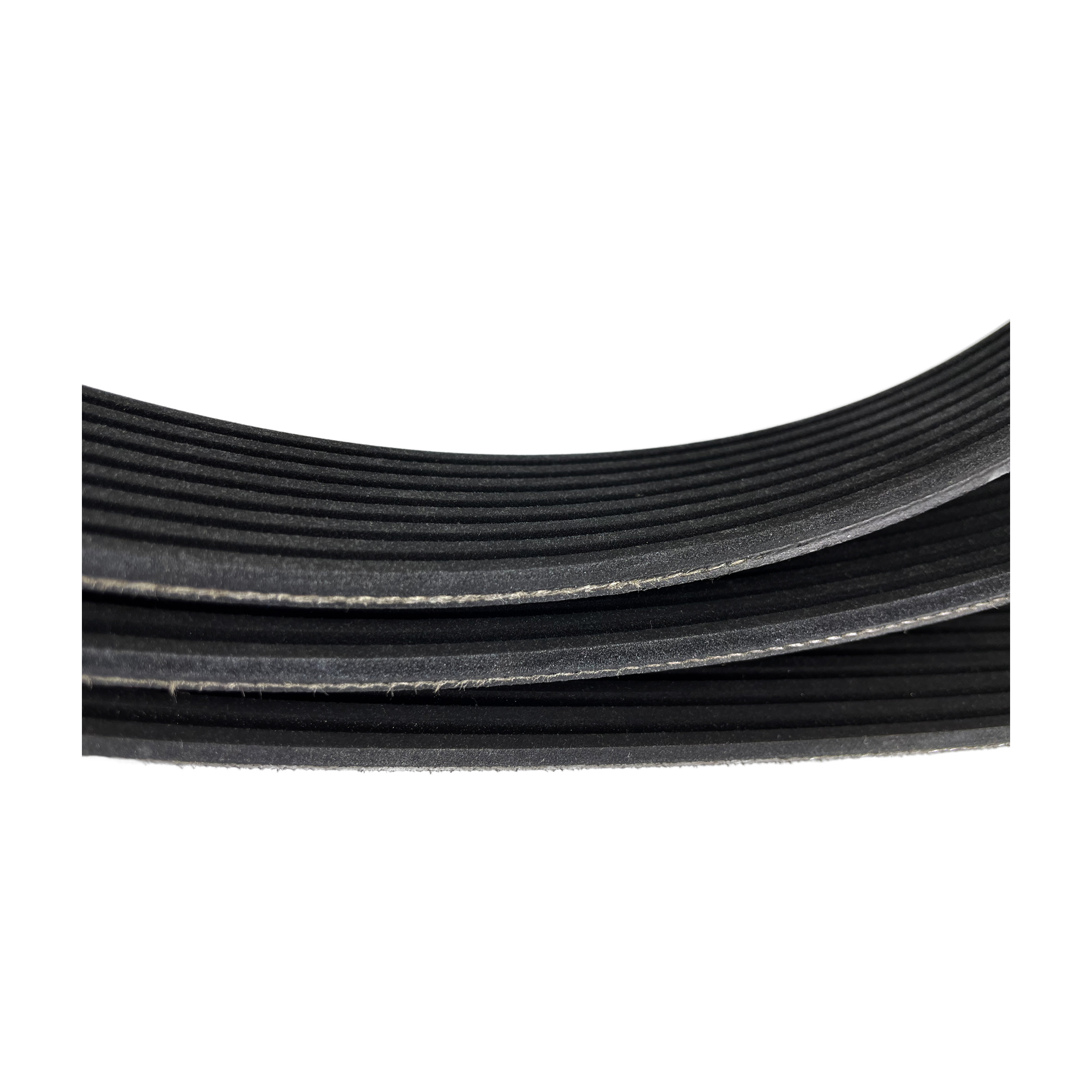
A precision belt remains only as reliable as the pulley it rides upon. This matching mandate forms the foundation of power transmission engineering. Pulleys require microscopic accuracy across three critical engineering dimensions: groove angle, pitch distance, and root radius. If any single dimension deviates from the standard, the belt cannot seat properly. Poor seating concentrates dynamic loads unevenly, destroying internal tensile cords.
Every belt profile demands strict adherence to minimum pulley diameters. You cannot cheat these physics. When bending a thick material around a tiny circumference, you induce severe flex fatigue. For example, a heavy-duty PM profile requires substantially larger pulleys than a nimble PJ profile. Dropping below the manufacturer-specified minimum diameter causes the backing material to snap under repetitive stress.
Accurate wear and tear assessment prevents unexpected downtime. You must inspect existing pulleys systematically. Use a specialized groove gauge. If you observe the belt ribs bottoming out inside the pulley grooves, the hardware has failed. A worn-out pulley cannot grip properly. The belt must wedge firmly by its flanks. It should never sit flat against the bottom of the groove.
Procurement teams face common sourcing challenges between custom and off-the-shelf components. Standard commercial pulleys are widely available and strictly regulated. However, custom machining introduces severe risks. Machine shops must adhere rigidly to ISO 9982 or DIN 7867 standards. Failing to polish the groove walls adequately leaves microscopic burrs. These burrs act like sandpaper, inflicting micro-abrasions onto the rubber ribs.
Disconnect all system power and perform standard lockout procedures.
Shine a high-lumen flashlight directly behind the seated belt.
Look for light bleeding through the bottom of the grooves. Light indicates bottoming out.
Insert a precision profile gauge into the empty pulley grooves to check flank wear.
Replace the entire pulley immediately if groove walls show concave dishing.
We evaluate belt materials primarily through a thermal lens. Power transmission proves highly sensitive to both ambient environmental heat and internal operational friction. As rubber compounds flex around pulleys, they generate intense internal temperatures. The chosen polymer must dissipate this heat efficiently. It must also resist chemical breakdown over thousands of operational hours.
Neoprene, technically known as chloroprene rubber (CR), represents the legacy standard. Decades ago, engineers favored neoprene for its acceptable oil resistance and moderate cost. However, neoprene suffers from severe chemical limitations. Under sustained high temperatures, its polymer chains cross-link rapidly. This cross-linking causes the material to harden, crack, and ultimately disintegrate. It often requires frequent replacement in demanding environments.
Ethylene Propylene Diene Monomer (EPDM) stands as the definitive modern benchmark. Specifying an EPDM poly V belt transforms system reliability. The chemical structure of EPDM lacks fragile double bonds in its main chain. This unique molecular architecture grants it exceptional heat resistance. EPDM routinely withstands continuous operating temperatures up to 130°C (266°F) without deteriorating.
Beyond heat resistance, EPDM offers profound operational advantages. It remains highly flexible during extreme cold starts, preventing early morning belt snaps. It also delivers significant noise reduction. EPDM compounds naturally absorb vibration, eliminating annoying squeaks. Transitioning to these modern polymers actively reduces warranty claims. Facilities report massively extended maintenance intervals across high-load industrial environments.
Unlike standard deep-groove setups having some tolerance for minor misalignment, ribbed profiles require absolute precision. Laser alignment represents a non-negotiable necessity. You must achieve near-perfect parallel and angular alignment across all rotating shafts. Industry best practices dictate maintaining alignment within 0.5 degrees. Exceeding this tolerance forces the ribs to rub aggressively against the groove walls.
Implementing strict tensioning protocols determines the ultimate lifespan of your drive. Tensioning errors fall into two destructive categories. Under-tensioning represents the most common installation failure. Loose belts slip continuously against the metal grooves. This slipping causes thermal glazing, rendering the rubber slick and useless. It also generates the unmistakable, high-pitched squealing associated with poorly maintained engines.
Conversely, over-tensioning inflicts hidden, devastating damage. Mechanics sometimes overtighten a serpentine belt trying to cure a squeal. Excessive tension places immense radial loads onto the adjacent bearings. It destroys delicate bearing seals, causing rapid fluid leaks. Simultaneously, extreme tension stretches the internal polyester or aramid tensile cords beyond their elastic limits, snapping them internally.
Modern drive testing requires modern tools. We strongly recommend abandoning outdated manual deflection tests. Pressing a thumb against the belt span yields highly inaccurate baseline data. Instead, technicians must utilize sonic tension meters. You input the belt mass and span length into the meter, then strum the belt. The meter reads the resulting vibration frequency, ensuring perfectly calibrated installation accuracy every single time.
Successful ribbed drive integration relies entirely on matching your exact load requirement to the correct H, J, K, L, or M profile. You cannot guess these specifications. Selecting an EPDM compound guarantees maximum longevity by fighting thermal degradation effectively. Furthermore, you must verify exact pulley groove geometry. An incompatible pitch will destroy your replacement parts immediately.
Your next step requires a thorough mechanical audit. Before ordering replacement inventory, inspect your current pulley wear. Look for dished flanks and bottoming-out conditions. Consult directly with technical manufacturers to verify cross-section load capacities. Updating your installation protocols to include sonic tensioning and laser alignment will finalize a durable, high-efficiency drive setup.
A: No. The geometries are entirely incompatible. Ribbed belts require specialized multi-groove pulleys to distribute the load evenly. Forcing a flat, multi-ribbed profile into a deep, single V-groove destroys the ribs instantly and causes immediate slippage.
A: Count the exact number of ribs across the width. Next, identify the profile letter (PH, PJ, PK, PL, PM) by measuring the precise pitch spacing between the ribs. Finally, measure the effective outside length using a flexible tape.
A: Usually, a combination of severe pulley misalignment, inadequate tension, or trapped debris in the pulley grooves pushes the belt out of alignment. Worn-out tensioner springs or damaged idler bearings also cause excessive slack, leading to derailment.