 |


| Quantity: | |
|---|---|
2L 3L 4L 5L
The rubber lawn and garden V belt is a wrapped V belt with a trapezoidal cross-section that fits into V-shaped pulley grooves. The belt is constructed with a tension member embedded in a rubber body, and the entire assembly is encased in a fabric cover. The wrapped construction provides protection against abrasion, moisture, and environmental exposure encountered in outdoor lawn and garden equipment operation.
Inside the belt body, a low-stretch tension member runs longitudinally to transmit power and maintain belt length stability. The tension member is bonded to the rubber compound through a textile adhesion system that prevents separation under load. This construction supports minimal belt stretch during service life, reducing the need for frequent re-tensioning of equipment drive systems.

The lawn and garden V belt is available in four standard cross-section sizes (2L, 3L, 4L, and 5L), corresponding to different power transmission capacities for various equipment types.
Model | Top Width (inch) | Height (inch) | Angle | Typical Power Range |
|---|---|---|---|---|
2L | 0.25 | 0.16 | 40° | Fractional HP |
3L | 0.38 | 0.23 | 40° | Up to 1 HP |
4L | 0.50 | 0.31 | 40° | 1 to 8 HP |
5L | 0.63 | 0.38 | 40° | 5 to 20 HP |
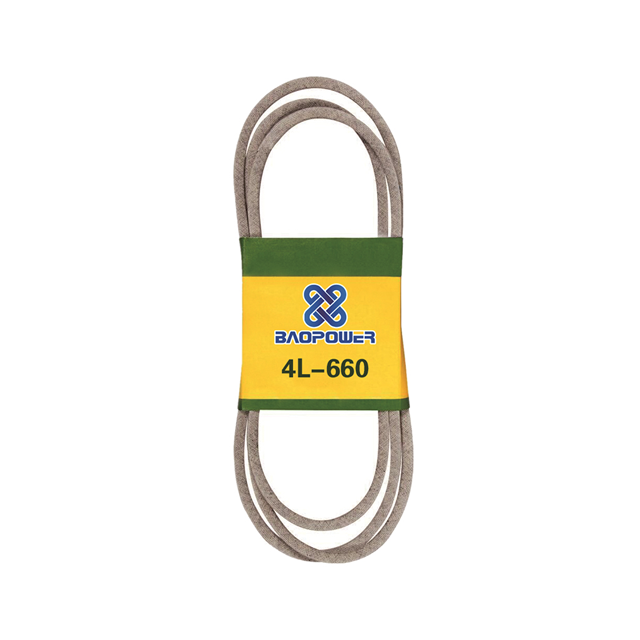
Belt length is indicated by the numerical portion of the model designation. The example marking "5L147.500" corresponds to a 5L cross-section belt with an outside length of 147.500 inches. Lengths are available across a range to fit different equipment configurations, from small push mowers to large riding tractors and commercial zero-turn mowers.
The lawn and garden V belts fall under the classical V belt classification, which is a widely adopted standard for light-duty and medium-duty power transmission applications. This standardization supports interchangeability with equipment from multiple manufacturers.
The rubber compound used in lawn and garden V belts is specifically formulated for ageing resistance, supporting performance stability over extended periods of outdoor storage and operation. The fabric cover provides additional protection against ultraviolet exposure, moisture, and dust encountered in lawn care and landscaping environments.
The belt exhibits high flexibility and low flex fatigue characteristics, which support consistent performance when the belt operates around multiple pulleys in serpentine drive configurations. The wrapped construction distributes flex stresses across the belt cross-section, contributing to longer service life in equipment that undergoes frequent start-stop cycles.
The wrapped fabric cover provides a wear-resistant outer surface that contacts pulley grooves. This cover layer protects the rubber body from abrasion caused by dust, grass clippings, and debris present in lawn and garden operating environments. Wear resistance contributes to longer belt life and reduced replacement frequency for commercial landscaping operations.
The V belt design produces smooth running operation with low noise levels during equipment use. The fabric cover dampens vibration and reduces resonance that can occur with bare rubber belts running on metal pulleys. This supports operator comfort during extended mowing or landscaping sessions.
Lawn and garden V belts are used in various outdoor power equipment, including walk-behind lawn mowers, riding mowers, garden tractors, zero-turn mowers, snow blowers, tillers, wood chippers, and leaf blowers. They transmit power from the engine to components such as mower decks, blade spindles, transmissions, and auger systems.
The correct belt size can be found in the equipment operator's manual or by checking the part number printed on the existing belt. If the original belt is missing or the markings are illegible, the belt size can be determined by measuring the pulley groove dimensions and center distance between pulleys, then calculating the required belt length using standard V belt length formulas.
Wrapped V belts have a fabric cover encasing the entire belt body, providing abrasion resistance and protection against environmental factors. Cogged V belts have notches on the inner surface that reduce bending resistance and heat buildup. For lawn and garden applications, wrapped V belts are commonly specified because the fabric cover offers better protection against grass, dirt, and debris encountered in outdoor mowing environments.
Replacement frequency depends on usage hours, operating conditions, and maintenance practices. For residential use, belts typically last 2 to 5 seasons. For commercial landscaping operations with daily use, belts may require replacement every 1 to 2 seasons. Signs that a belt needs replacement include visible cracking, fraying of the cover fabric, glazing or hardening of the belt surface, or noticeable slippage under load.