 |


| Quantity: | |
|---|---|
AV10 AV13 AV15 AV17 AV22
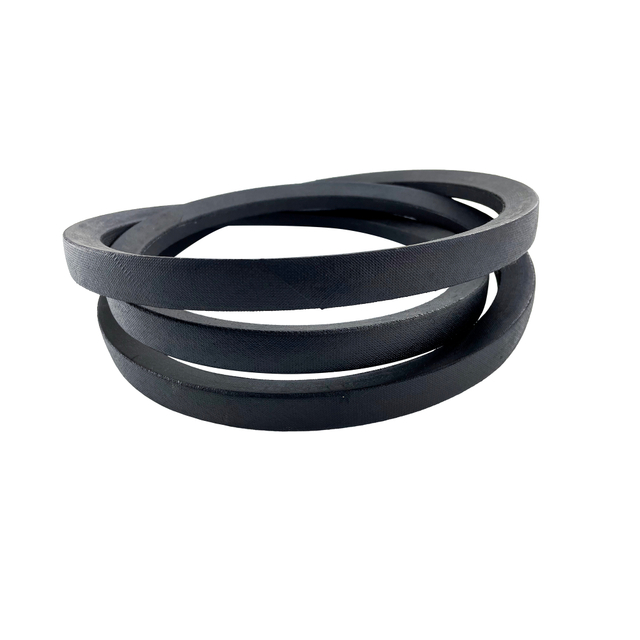
The EPDM automobile teeth V belt features a moulded notch construction that increases belt flexibility and reduces bending stresses during operation. The cogged profile allows the belt to wrap around smaller diameter pulleys with less resistance, which contributes to lower energy consumption compared to standard wrapped V belts. This design also enhances heat dispersion across the belt surface, supporting consistent performance under elevated engine compartment temperatures.
Manufactured from EPDM (ethylene propylene diene monomer) rubber compound, the belt exhibits resistance to ozone, weathering, and thermal aging. Embedded polyester tensile cords run longitudinally within the belt body, providing structural strength and dimensional stability. The rubber compound is formulated to withstand oil exposure and temperature fluctuations commonly encountered in automotive engine environments.

The EPDM teeth V belt is available in five standard cross-section sizes to accommodate different pulley configurations and power transmission requirements across various vehicle models.
Model | Top Width (mm) | Height (mm) | Angle |
|---|---|---|---|
AV10 | 10 | 6 | 40° |
AV13 | 13 | 8 | 40° |
AV15 | 15 | 10 | 40° |
AV17 | 17 | 11 | 40° |
AV22 | 22 | 14 | 40° |
Product markings on the belt surface indicate both cross-section size and effective length. The example designation "AV10×1280" corresponds to an AV10 profile belt with an effective length of 1280 mm. Length availability varies by model to suit different engine layouts and accessory drive configurations.
The cogged V belt design delivers power transmission through frictional contact between the belt sidewalls and pulley grooves. The moulded notch geometry reduces bending fatigue, which supports longer service intervals and reduces the frequency of replacement. For commercial procurement managers, this translates to fewer maintenance interventions and lower associated labor costs over the belt lifecycle.
EPDM material properties allow the belt to operate within a temperature range suitable for most passenger and commercial vehicle engine compartments. The rubber compound resists degradation from incidental oil contact and exposure to engine fluids, which helps maintain belt integrity during routine service life.
Compared with wrapped V belt alternatives, the cogged design operates with lower energy loss due to reduced bending resistance. The zero-maintenance characteristic means no periodic lubrication or adjustment is required beyond standard tension checks during scheduled vehicle servicing.
Production of EPDM teeth V belts follows a multi-stage manufacturing process that includes rubber compound mixing, belt building, vulcanization, and final inspection. Each stage incorporates dimensional checks and material property testing to verify that finished belts meet specified tolerances for length, width, and cross-sectional profile. Consistent dimensional accuracy across production batches supports interchangeability and reduces installation time for fleet maintenance operations.
Rubber compound properties including hardness, tensile strength, and elongation at break are tested during production to verify compliance with formulation specifications. Tensile cord adhesion strength is also evaluated to confirm that the bond between the cord and rubber body meets established performance criteria.
EPDM teeth V belts are used in passenger cars, light commercial vehicles, and heavy-duty truck engine accessory drive systems. Common applications include alternator drives, water pump drives, power steering pump drives, and air conditioning compressor drives. The specific model and length required depend on the vehicle manufacturer's pulley system design.
A cogged (teeth) V belt has notches moulded into the inner surface that run perpendicular to the belt length. These notches allow the belt to bend more easily around small-diameter pulleys, reducing heat buildup and energy loss. A wrapped V belt has a fabric cover encasing the entire belt body and generally operates at higher tension levels with greater energy consumption.
Replacement intervals vary by vehicle manufacturer and operating conditions. Most automotive manufacturers specify inspection at scheduled service intervals, typically every 60,000 to 100,000 kilometers, with replacement based on visual inspection of belt condition, including crack formation, fraying, or glazing on the sidewalls.
EPDM rubber retains flexibility at low temperatures, which supports belt performance in cold climate regions. The material resists cracking from temperature cycling between cold start conditions and normal operating temperatures.
EPDM teeth V belts in the AV17 and AV22 sizes are commonly specified for heavy-duty commercial vehicle accessory drive systems, including truck alternators, cooling fans, and air conditioning compressors. The EPDM compound provides thermal stability for extended operation under high-load conditions, and the cogged design reduces heat buildup in applications with multiple pulley wraps.