 |


| Quantity: | |
|---|---|
PH PJ PK PL PM
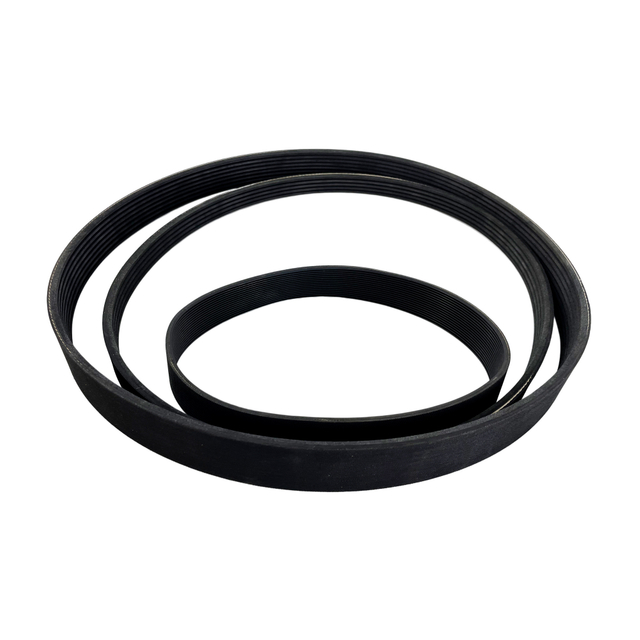
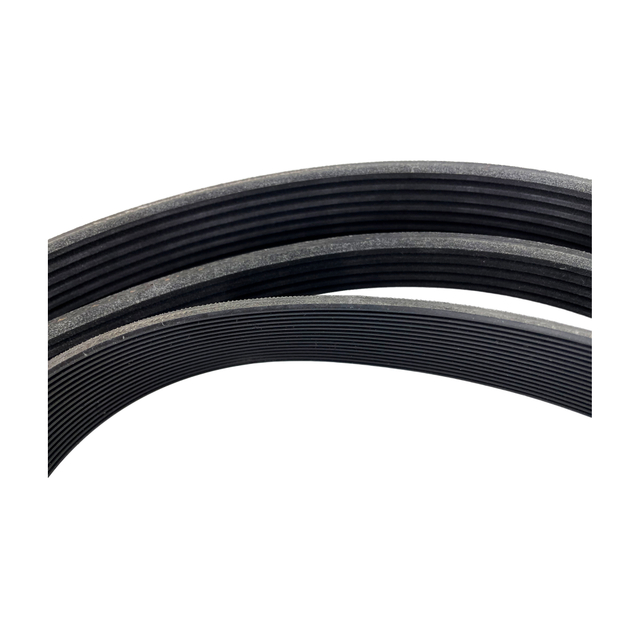
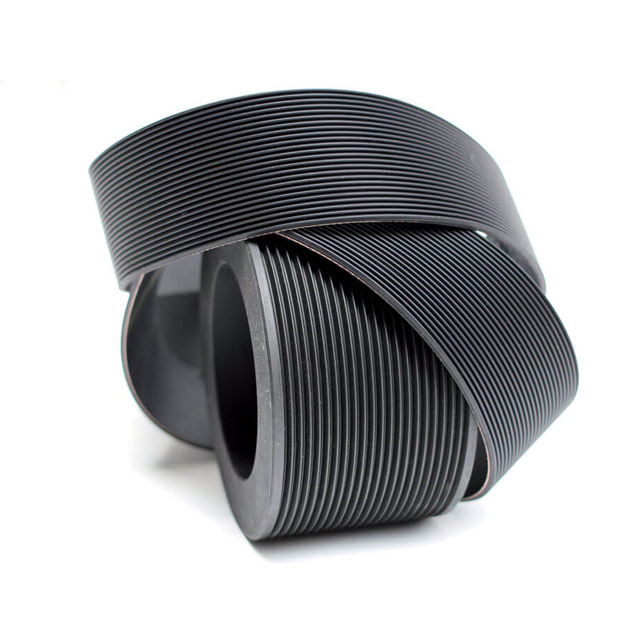
Poly V belts, also referred to as ribbed V belts or multi-rib belts, are power transmission components featuring multiple longitudinal V-shaped ribs along the belt surface. Each rib engages with a corresponding groove on the pulley, distributing load across a wider contact area compared to conventional single V belts.
The belt body uses EPDM rubber compound formulated for thermal stability and flex resistance. Short aramid fibers are oriented within the rib structure to withstand lateral pressure during operation and maintain rib geometry under load. The back surface incorporates a fabric layer for abrasion resistance against idler pulleys and backside idlers.
A polyester tensile cord runs longitudinally along the belt neutral axis to carry the primary tension load. The cord is treated for adhesion compatibility with the rubber compound to prevent delamination under cyclic loading. Rib geometry follows a trapezoidal profile with a 40-degree included angle, matched to standard pulley groove dimensions for uniform load distribution across all ribs.

Section | Rib Pitch (mm) | Approx. Top Width per Rib (mm) | Approx. Belt Height (mm) |
|---|---|---|---|
PH | 1.60 | 1.36 | 2.70 |
PJ | 2.34 | 2.00 | 4.00 |
PK | 3.56 | 3.00 | 5.30 |
PL | 4.70 | 4.00 | 7.00 |
PM | 9.40 | 8.00 | 12.00 |
Belt speed ranges up to 40 m/s depending on section size and pulley diameter. Operating temperature spans from -30°C to +80°C for standard EPDM compounds. Length tolerance follows ISO 9982 specifications, and elongation after run-in typically remains below 1.5 percent. The multi-rib design enables power transmission across compact drive layouts with smaller pulley diameters compared to classical V belt sections.
PK section belts serve as front-end accessory drive (FEAD) components in passenger vehicles and commercial trucks, driving alternators, water pumps, air conditioning compressors, and power steering pumps from a single belt path. The ribbed profile accommodates serpentine layouts with multiple idlers and backside contact points.
PJ and PH sections find use in HVAC blowers, washing machines, tumble dryers, and portable power tools where space is constrained and drive ratios require small pulley diameters. PL and PM sections apply to larger industrial machinery, agricultural equipment, and exercise equipment requiring higher torque transmission.
Production adheres to ISO 9982 for poly V belt dimensions and tolerances, and SAE J1459 for automotive accessory drive belt specifications. Raw materials undergo incoming inspection including rubber hardness testing, cord tensile strength verification, and fabric adhesion tests.
Each production batch passes through three inspection stages: dimensional verification of rib profile and pitch, static tension testing to confirm cord integrity, and length matching within designated tolerance groups. Finished belts receive lot traceability coding for production date, material batch, and inspection records.
PK belts have a rib pitch of 3.56 mm and are commonly used in automotive accessory drives. PJ belts have a narrower rib pitch of 2.34 mm and are used in appliances and smaller machinery where pulley diameters are smaller and space is limited.
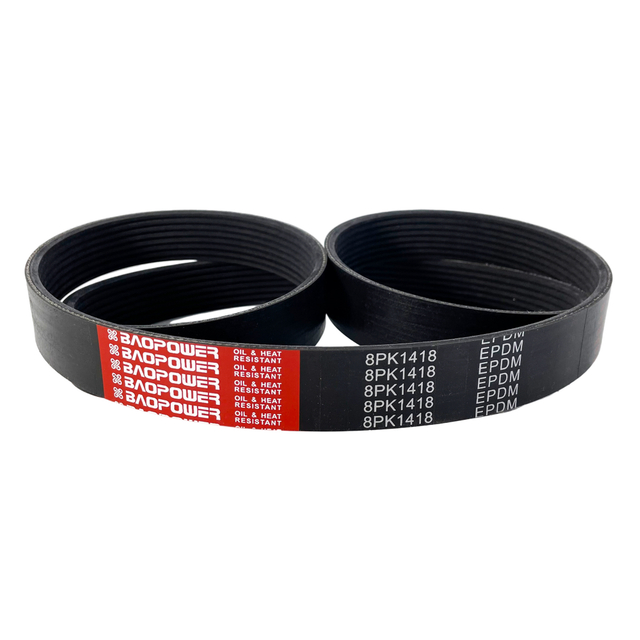
Belt length is determined by measuring the pitch length, which corresponds to the neutral axis of the tensile cord. Consult the drive design calculation based on center distance, pulley diameters, and number of grooves. Length codes printed on the belt indicate the effective length in millimeters or inches.
The minimum recommended pulley diameter for PK section belts depends on the number of ribs and drive ratio. For standard PK belts, the minimum sheave diameter typically starts at approximately 45 mm for the backside and 60 mm for the grooved side, though values vary by manufacturer and application load.
Standard EPDM poly V belts offer limited oil resistance. For applications with significant oil exposure, such as engine compartments with potential leaks, belts with oil-resistant rubber compounds are available. Consult the specification sheet for the specific oil resistance rating of the selected belt series.